


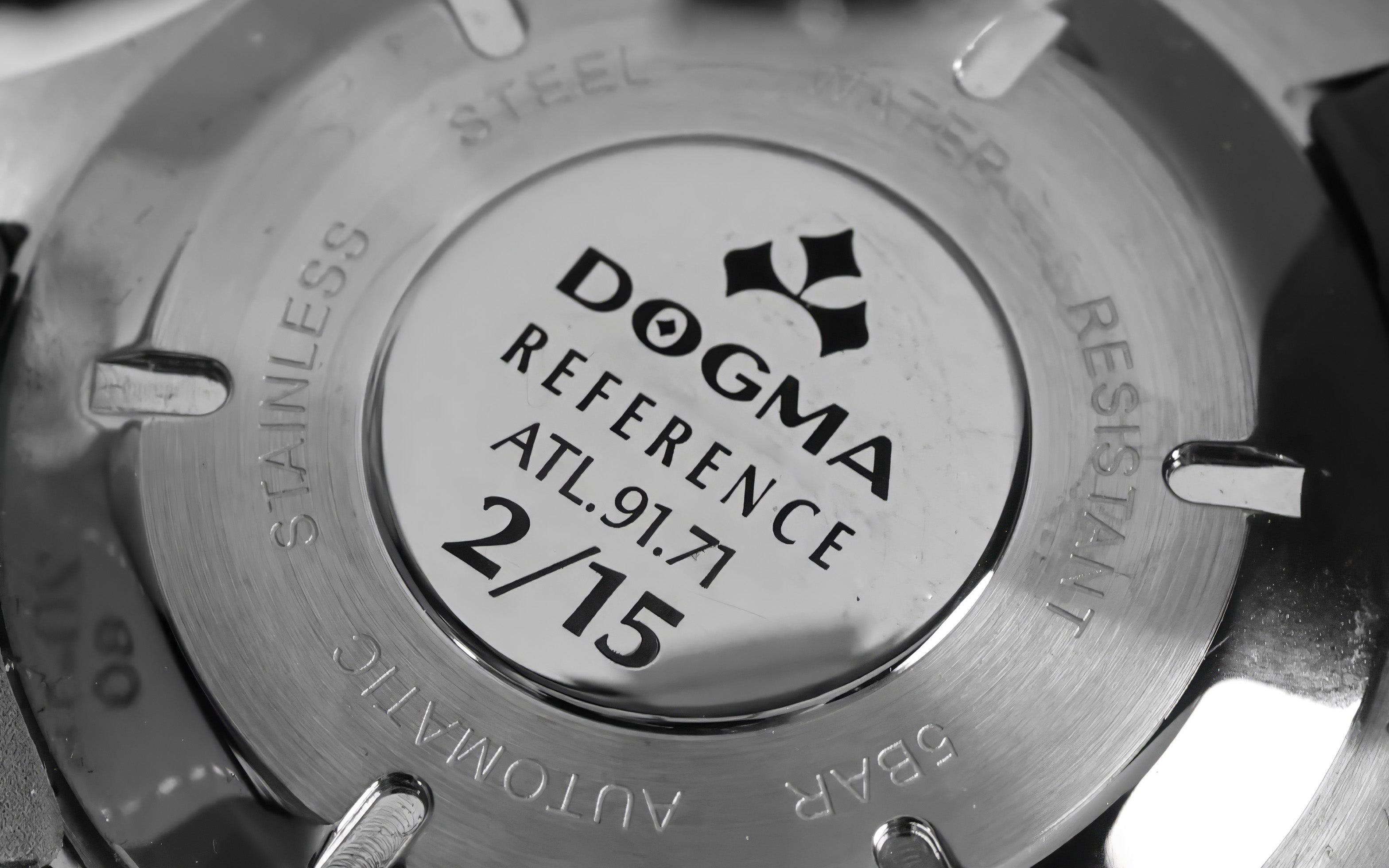
Dogma Watches began with a simple question: what should an independent watch studio be now?
Not what should it imitate. Not which heritage language should it borrow. Not how quickly it can appear established. But what kind of object, practice, and point of view can it bring into the watch world today?
Modern Dogma is the answer we are building toward.
It is not a rejection of horology’s past. Mechanical watches carry history by nature. They belong to a long lineage of instruments, objects, rituals, and details. But Dogma is not interested in treating that history as a costume. The goal is not to reproduce the language of another era, or to rely on nostalgia as the primary source of meaning.
Dogma is interested in what a mechanical watch can be now: design-led, physically considered, visually precise, and built with enough restraint to remain convincing over time.
That is the working definition of Modern Dogma.

A modern watch does not need to look futuristic
Modernity is often confused with futurism. In watches, that can lead to exaggerated forms, aggressive surfaces, synthetic visual language, and complexity used as a substitute for clarity.
Dogma takes a different view.
A modern watch does not need to look like it arrived from the future. It needs to be aware of the present. It should understand how people wear objects today, how visual culture has changed, how materials and processes can be used differently, and how much noise already surrounds the category.
Modernity, for Dogma, is not an aesthetic trick. It is a design position.
It shows up in proportion, hierarchy, ergonomics, surface language, and the relationship between concept and object. It shows up in what is removed as much as what is added. It shows up when a watch can feel distinct without becoming loud, and expressive without losing control.
A modern watch should not depend on novelty alone. Novelty fades quickly. The stronger question is whether the object still feels resolved after the first impression passes.
Design-led, not style-led
Dogma is design-led, but that phrase needs to be handled carefully.
Design-led does not mean styling-led. It does not mean making a watch unusual for the sake of being unusual. It does not mean applying a visual identity at the end of the process and asking the object to carry more meaning than its structure can support.
For Dogma, design is the discipline that shapes the whole object.
It decides how the dial is read. It decides how much visual prominence each element deserves. It decides how the case carries mass, how the watch sits on the wrist, how surfaces transition, how depth is introduced, and how the object communicates before a single specification is explained.
That is why proportion matters so much. Diameter alone does not define a watch. A case can be compact and still feel heavy. A dial can be detailed and still feel clear. A watch can have presence without becoming oversized. The relationship between thickness, lug stance, dial opening, bezel mass, bracelet or strap integration, and visual weight determines whether the watch feels composed or merely assembled.
Modern Dogma begins there: with the belief that design quality is not decoration. It is judgment made visible.
Between heritage revival and disposable novelty
Much of the watch world sits between two familiar poles.
On one side, there is heritage revival: watches built around the language of the past, often with great charm and legitimacy, but sometimes with little reason to exist beyond resemblance.
On the other side, there is disposable novelty: releases built to create immediate reaction, social visibility, or short-term difference, without enough internal logic to remain meaningful.
Dogma does not belong comfortably to either side.
The studio is not trying to erase history. It is also not trying to live inside it. The goal is to build watches that understand the weight of the category without being trapped by it.
That means using mechanical watchmaking as a serious foundation, while allowing the design language to come from a broader world: product design, architecture, material studies, visual systems, typography, craft, and contemporary object culture.
This is where Dogma sits in the horology universe: not as a heritage reenactment, not as a fashion accessory, not as a spec-sheet microbrand, and not as an art object detached from use.
Dogma is a modern independent watch studio focused on design-led mechanical watches, small runs, and objects that hold attention through clarity, proportion, and meaning.
The role of Atelier
Atelier is an important part of understanding Modern Dogma.
Before a brand becomes clear from the outside, it has to become clear from the inside. Atelier is where that work happens physically. It is the studio’s space for prototypes, one-offs, material studies, dial experiments, and design exploration.
These pieces are not side projects. They are evidence of practice.
Atelier allows Dogma to test ideas in material form: laser-annealed stainless steel, layered mother-of-pearl, engraved and filled surfaces, printed depth, metal masks, anodized elements, hand finishing, unusual color behavior, and different relationships between dial, case, strap, and wrist.
Some Atelier watches may feel closer to production language. Others may remain studies. That distinction matters. Not every experiment should become a permanent collection, and not every successful prototype should be repeated.
But each study teaches something.
A prototype can reveal how light moves across a surface. It can show whether a dial has enough hierarchy. It can test whether visual complexity becomes depth or noise. It can expose how color behaves under different conditions. It can show whether an idea has emotional presence once it leaves the render and becomes an object on the wrist.
This is why Atelier matters to Dogma. It makes the brand less abstract. It shows the working process behind the point of view.
Monograph as the formal expression
If Atelier is the exploratory side of Dogma, Monograph is the formal one.
Monograph represents the studio’s more resolved release structure: watches developed as complete chapters within a larger system. These are not experiments in the same way Atelier pieces are. They are intended to carry Dogma’s design language with greater permanence, coherence, and production discipline.
Monograph Istanbul is the first expression of that direction.
Its launch and delivery timeline may continue to develop, but its role inside Dogma is already clear. It establishes the studio’s ambition for a flagship object: mechanical, considered, conceptually grounded, and visually controlled.
Atelier and Monograph are not contradictions. They are two parts of the same practice.
Atelier asks questions.
Monograph answers them more formally.
One protects exploration. The other protects coherence.
Together, they make Dogma more legible.
Small runs as a design choice
Small-run production is often discussed as scarcity. For Dogma, it is more useful to think about it as control.
A smaller run allows the studio to stay closer to the object. It keeps decisions visible. It makes the development process more deliberate. It allows a watch to exist as part of a focused body of work rather than as one more item in an expanding catalog.
This does not mean scarcity should be theatrical. Dogma is not interested in limited numbers as a substitute for design value.
Small runs matter when they support the integrity of the work. They allow the studio to move carefully, test intelligently, refine honestly, and avoid building more than the idea can justify.
That is especially important for a young independent brand. Growth should not come at the expense of clarity. A larger catalog can make a brand appear more complete, but it can also make it harder to understand.
Dogma would rather be narrow and clear than broad and forgettable.
What Modern Dogma stands for
Modern Dogma stands for mechanical watches shaped by design judgment.
It stands for proportion over posturing.
Hierarchy over visual noise.
Ergonomics over image alone.
Material behavior over surface gimmick.
Small runs over mass product.
Studio practice over empty storytelling.
Presence over spectacle.
It stands for the belief that a watch can be modern without being cold, expressive without being excessive, and meaningful without pretending to be older than it is.
That is the space Dogma is building into.
The brand is still young. The language is still becoming sharper. The prototypes are part of that process. Monograph Istanbul is part of that process. Every study, release, image, and written piece is part of the same effort: to make Dogma clearer, more coherent, and more worthy of attention.
Modern Dogma is not a finished claim.
It is a standard.
A way to decide what belongs, what does not, and what deserves to become an object of time.
Explore the Atelier prototypes and the first Monograph direction from Dogma Watches.
Share:
Introducing Dogma Watches
Atelier: Where Dogma Watches Learns in Public