


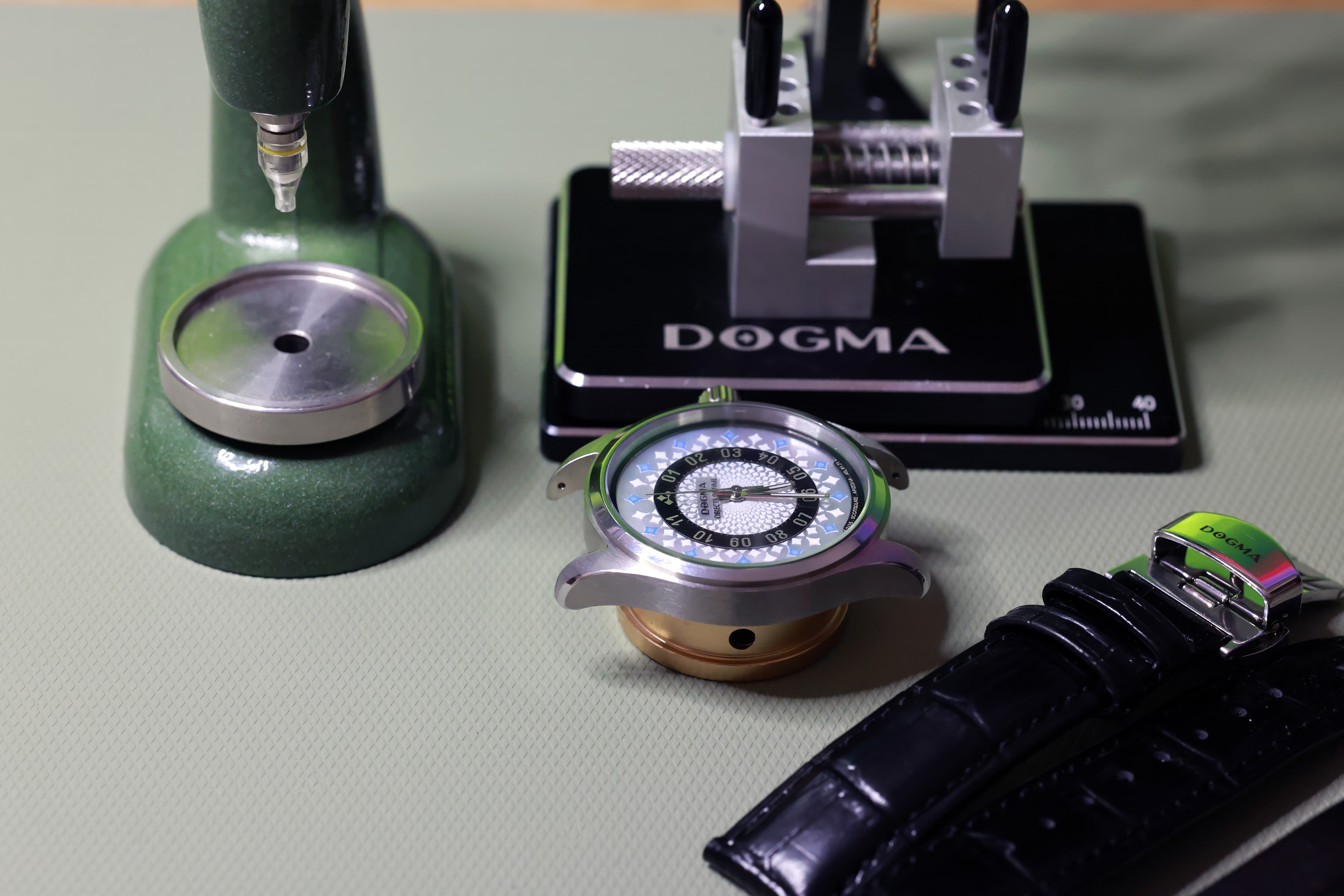
Atelier: Where Dogma Watches Learns in Public
Every studio needs a place where ideas are allowed to remain unresolved for a while.
Not unfinished. Not careless. Unresolved in the productive sense: still open to material, light, proportion, failure, correction, and surprise.
For Dogma Watches, that place is Atelier.
Atelier is the experimental layer of the studio: a space for prototypes, one-offs, material studies, dial constructions, and small-run watches that sit between sketch and formal collection. It is where Dogma can ask questions physically before deciding which answers deserve permanence.
A watch brand can be described in language. It can be positioned, named, rendered, and announced. But eventually, the object has to carry the thought.
Atelier is where that thought becomes tangible.

Atelier is the experimental layer of Dogma Watches: a space for prototypes, one-offs, and material studies.
A sketchpad, but in metal
The word prototype often suggests something temporary: a test model, an unfinished attempt, a necessary step before the real product arrives.
Atelier treats the prototype differently.
Here, the prototype is not only preparation. It is a form of thinking. It is a sketchpad, but in metal, glass, resin, pearl, steel, color, and wrist presence. Some ideas become clearer only after they leave the screen. Some surfaces only reveal their logic when they catch light. Some proportions only become honest when they are worn.
This is why making matters.
An idea can be seductive when it exists as a render, a phrase, or a reference. Making changes the standard. The object gains thickness. It gains edge conditions. It gains reflections, tolerances, weight, flaws, and resistance. It begins to answer back.
That resistance is useful. It gives the idea accountability.
Atelier is the part of Dogma where that accountability is welcomed.
Looking outside the watch world
Many Dogma ideas begin somewhere else.
A shadow. A building surface. A fragment of pattern. A memory of a material. A transition between matte and polished. A geometry found in ordinary life. A cultural detail detached from its original scale. A moment where something familiar suddenly looks like it could become an object.
The starting point is often not a watch.
That matters because Dogma is not trying to build its design language only by looking at other watches. Horology has a long and valuable memory, but memory can become a closed room. Atelier keeps the studio looking outward.
The work is translation.
A detail from everyday life is not copied directly. It is reduced, edited, disciplined, and reimagined at the scale of a watch. Sometimes it becomes a dial texture. Sometimes a layered surface. Sometimes a color behavior. Sometimes a visual rhythm. Sometimes it remains only a study, a trace of an idea that may return later in another form.
This is how Dogma’s prototypes can differ from one another and still feel related.
The family resemblance is not built by repeating one graphic gesture. It comes from a consistent way of seeing: observe, translate, make, edit.
 Many Dogma ideas begin outside the watch world, then are translated into the scale and discipline of a watch.
The dial as a small architecture
Atelier often begins with the dial because the dial is where a watch becomes most compressed.
It is a small architecture of information, depth, surface, symbol, and restraint. It must be read quickly, but it can reward looking slowly. It has to carry identity without collapsing into decoration. It has to hold proportion across distances: from across a room, on the wrist, and under close inspection.
In that limited space, every decision becomes amplified.
A fraction of a millimeter can change the balance. A color can advance or disappear. A reflective surface can create depth or confusion. A cutout can make the dial feel architectural, or simply busy. A marker can behave as information, ornament, or interruption.
This is where Atelier becomes most useful.
It lets Dogma study the dial not as a graphic surface, but as a field of relationships: light against shadow, layer against layer, figure against ground, meaning against restraint.
The goal is not complexity. Complexity is easy to add.
The harder task is to create presence without noise.
The dial is a small architecture of information, depth, surface, and restraint.
Materials with a voice
Materials are never silent.
Mother-of-pearl carries movement before anything is printed on it. Stainless steel can become cold, architectural, or optical depending on how it is treated. German silver has a softness and warmth beneath its surface discipline. Rhodium plating can sharpen a form. Anodized aluminum can shift tone. Resin can hold depth and memory. Engraving can make shadow part of the composition.
Atelier gives Dogma a place to listen to these behaviors.
This is not material novelty for its own sake. A strange material is not automatically a better one. An unusual finish can easily become an effect, and effects often age quickly.
The question is whether the material contributes to the watch’s language.
Does it help the dial breathe?
Does it clarify hierarchy?
Does it create depth without spectacle?
Does it change with the wrist, the light, the day?
Does it make the object more convincing after the first look?
When the answer is yes, material becomes more than surface. It becomes part of the object’s meaning.

Material is not decoration at Atelier. It is one of the ways the object thinks.
Four studies, four questions
The current Atelier prototypes do not behave like a conventional collection. They are closer to a set of studies, each asking a different question.
Parallax studies light, stainless steel, and optical movement. Its laser-annealed dial shifts with angle, creating a sense of motion without a moving part. The geometry is fixed, but the surface is not passive.
Glyph Studies explores mother-of-pearl, layering, and controlled ornament. It asks how decoration can be present without becoming indulgent; how a dial can carry richness without losing order.
Vestige moves closer to memory and surface. Through engraving, resin, plating, and fill, it studies how a dial can feel marked, worked, and materially present without relying on nostalgia.
ATL.91.71 asks another question: what happens when the study is worn? It is less about the dial as an isolated image and more about the object in ordinary life — on the wrist, in motion, under changing light, away from the studio.
Together, these watches show range. But more importantly, they show method.
They are not unified by a single motif. They are unified by a standard: proportion, hierarchy, material behavior, wrist presence, visual meaning, and restraint.

The Atelier prototypes are not unified by one motif. They are unified by a method.
The courage of making
There is a private comfort in having an idea.
An idea can remain perfect because it has not yet been tested. It can avoid the compromises of material, production, time, money, scale, and use. It can stay suspended as potential.
Making removes that comfort.
To make something is to let the idea become vulnerable. It can fail. It can look weaker than expected. It can become too heavy, too quiet, too loud, too literal, too fragile, too decorative, too unclear. It can expose the distance between intention and object.
But that is also why making is necessary.
Atelier is Dogma’s way of moving beyond the safety of ideas. It is where design becomes brave enough to be judged. Not by intention, but by presence. By how it sits. How it reads. How it catches light. How it behaves on the wrist. How it holds together after the first impression.
This is learning through making, but it is also learning through consequence.
For Dogma, that consequence is part of the beauty of the practice.
Atelier and Monograph
Atelier is not a detour from Dogma’s formal work. It is part of the structure that makes the formal work possible.
Atelier asks questions.
Monograph formalizes answers.
Atelier gives the studio room to explore without forcing every experiment into permanence. Monograph gives Dogma a place to resolve selected ideas into more complete releases with stronger continuity, clearer architecture, and greater production discipline.
The distinction protects both sides.
Without Atelier, Dogma could become too fixed too early. Without Monograph, it could remain too open to be understood. One side keeps the studio alive to discovery. The other gives the brand a framework for coherence.
This is why the two should be read together.
Atelier is the sketchpad.
Monograph is the manuscript.

Atelier asks questions. Monograph formalizes answers.
A studio becoming legible
Atelier matters now because it makes Dogma visible as a working studio.
It shows that the brand is not only a future launch or a finished claim. It is already a practice: observing, translating, testing, editing, wearing, revising. It gives shape to the design intelligence behind the name.
It also helps clarify where Dogma belongs.
Not as a heritage revival brand.
Not as a fashion watch label.
Not as a spec-sheet microbrand.
Not as an art object detached from use.
Dogma is a design-led independent watch studio using prototypes, small runs, and formal releases to develop a more considered mechanical watch language.
Atelier is the clearest evidence of that language in motion.
Explore Atelier
The current Atelier prototypes are studies, one-offs, and small-run experiments from Dogma Watches.
They are not meant to explain the entire brand at once. They are meant to show how Dogma thinks with objects: through material, proportion, light, wearability, restraint, and the courage to make.
Explore Atelier and follow the studio practice behind Dogma Watches.

Explore Atelier: studies, one-offs, and small-run experiments from Dogma Watches.
Share:
What Is Modern Dogma?