


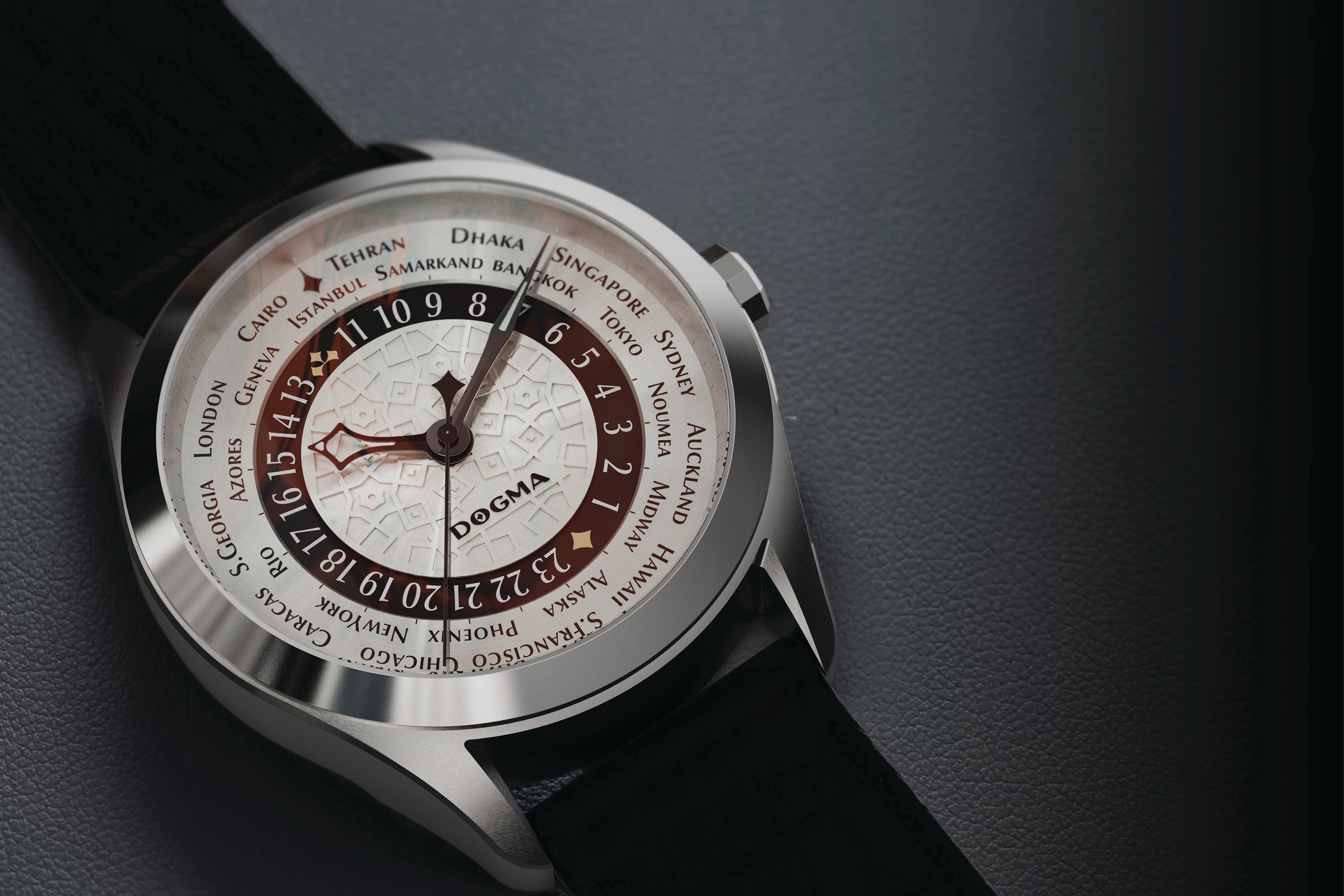
Dogma Watches is an independent Arizona watch studio creating design-led mechanical watches in small runs.
The studio was created with a simple belief: a watch should feel considered. Not only in its styling, but in its proportions, visual hierarchy, ergonomics, and the coherence of the object as a whole.
Dogma approaches watchmaking as a design discipline. That means form is not treated as decoration applied at the end of the process, and identity is not built through noise, nostalgia, or unnecessary complexity. Each watch is meant to feel deliberate, resolved, and worth living with over time.
This point of view shapes the studio from the beginning.
An independent watch studio in Arizona
Dogma is based in Arizona and developed as an independent studio with a focused approach to mechanical watches, limited production, and long-term brand coherence.
Rather than building a broad catalog quickly, Dogma is being shaped carefully through a smaller body of work. The aim is not constant output. It is clarity.
That means each release should have a reason to exist. Each object should contribute to a larger design language. And each decision, from proportions and materials to layout and finishing, should support the integrity of the whole.
Arizona is part of that story not as a marketing device, but as a point of grounding. Dogma is being built with independence, discipline, and close attention to the object itself.
Design-led mechanical watches
Dogma focuses on mechanical watches because they remain one of the clearest examples of object, function, and meaning coming together in daily life.
A mechanical watch is useful, but it is also lived with. It is worn repeatedly, read repeatedly, and judged over time. Its quality is not only a matter of specification or price. It is felt in the way the watch resolves on the wrist and in the eye.
For Dogma, design-led means more than having a distinctive look. It means prioritizing the structure behind the appearance of the watch.
Proportion matters. A watch should feel balanced in diameter, thickness, opening, and stance.
Hierarchy matters. The most important information should be given visual priority, while secondary information should support rather than interrupt the reading of the object.
Ergonomics matter. A watch should not only photograph well. It should wear well, sit well, and maintain its intended character on the wrist.
Semantics matter. Form always communicates something. Shapes, surfaces, transitions, and details all contribute to the tone of the object. Dogma is interested in watches whose visual language is deliberate enough to say the right thing without excess.
Built through studio practice
Dogma began not only as a brand idea, but as a working studio practice.
Before the first official Monograph, the studio developed a series of prototypes, studies, and one-off watches exploring dial construction, finishing, surface treatment, proportion, and visual language.
Some were made to test materials. Some explored handmade dial techniques. Some examined how texture, color, geometry, and depth could change the character of a watch without relying on excess. These studies used a range of processes, including laser work, CNC machining, UV printing, plating, sanding, polishing, and hand-finishing.
Within Dogma, this experimental work belongs to Atelier.
Atelier is the studio’s space for prototypes, one-offs, handmade studies, and design experiments. It allows Dogma to preserve and share the exploratory side of the brand without confusing it with the main production collections.
These pieces are not presented as mass-production references. They are evidence of the studio’s development: the tests, studies, and physical experiments that help shape future releases.
Built in small runs
Dogma is built around small runs rather than mass production.
This is partly a practical choice, but more importantly it is a creative one. A smaller production model allows the studio to stay selective, protect coherence, and develop each release with greater care.
Small-run production also supports a more deliberate relationship between maker, object, and owner. It allows each watch to feel like part of a considered body of work rather than one more interchangeable product in an endless cycle of releases.
That approach requires patience. It also requires restraint. Not every idea should become a watch, and not every watch should become a permanent part of the collection.
Dogma would rather build selectively and clearly than grow quickly without identity.
Beginning with Monograph: Istanbul — World Time
Dogma begins its official Monograph series with Monograph: Istanbul — World Time.
As the first flagship release, it sets the tone for what the studio intends to build: mechanical watches with a strong design point of view, a clear visual language, and a closer relationship between concept and object.
Monograph: Istanbul is not intended as a loud debut. It is intended as a precise one. Its role is not only to introduce a product, but to establish a standard—clarity, proportion, controlled visual depth, and distinction that comes from design intelligence rather than spectacle.
More will be shared as Monograph: Istanbul develops. For now, it marks the opening expression of Dogma Watches as a formal collection and the beginning of a longer body of work.
What Dogma Watches stands for
Dogma Watches stands for a slower and more deliberate approach to the mechanical watch.
It stands for small runs over mass product.
Design discipline over visual noise.
Coherence over accumulation.
Presence over spectacle.
Studio practice over empty storytelling.
Objects meant to hold attention over products designed to disappear into the stream.
Atelier shows the exploratory side of that practice. Monograph: Istanbul — World Time begins the formal expression of it.
Dogma Watches is just beginning.
Share:
Why Dogma Exists: Objects of Time, Not Mass Product
What Is Modern Dogma?