


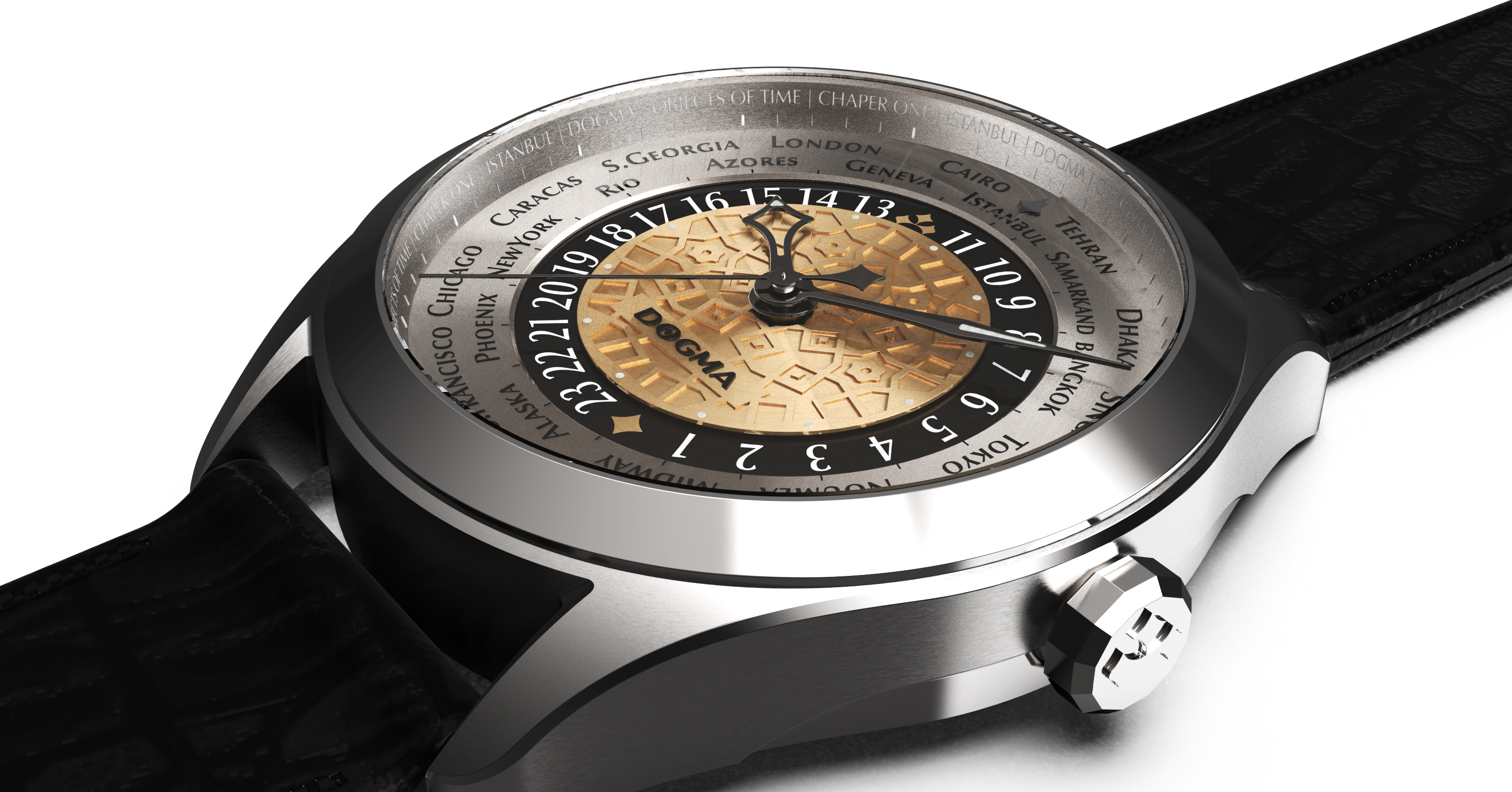
Dogma was not created to add more noise to an already crowded category. It was created from a simpler conviction: a watch should feel considered.
Too many products are designed to be consumed quickly. They borrow the same signals, repeat the same language, and ask to be noticed before they earn attention. In watches, that often means familiar case shapes, borrowed nostalgia, inflated claims of craftsmanship, and a kind of visual noise mistaken for depth.
Dogma takes a different view. We are interested in objects that hold attention longer. Objects shaped by restraint, proportion, clarity, and meaning. Objects made to reward close looking rather than demand instant reaction.
That idea sits at the center of the brand: Objects of Time.
A watch should feel considered before it feels expensive
Price can suggest quality, but it cannot create it. A watch feels meaningful long before its price is justified. It happens in the coherence of the object itself: the way the proportions resolve, the way the visual weight is distributed, the way depth is introduced and controlled, the way surfaces transition, and the way each element supports the whole rather than competing for attention.
That is the kind of value Dogma is interested in. Not luxury as theater, but design as discipline.
A compelling watch is not simply a collection of desirable ingredients. It is not made strong by adding more texture, more contrast, more references, or more visual cues associated with expense. In many cases, the object becomes weaker as more is added. The design starts to explain itself too loudly. It begins to rely on effect rather than order.
For Dogma, the real test is whether the watch feels resolved. Whether the dial has hierarchy. Whether prominence is given to the right information. Whether the case carries itself with clarity from every angle. Whether the ergonomics support the form rather than fight it. Whether the object communicates its character immediately, but reveals its intelligence more slowly.
These are not decorative concerns. They are structural ones.
Why proportion matters
Proportion is not styling. It is one of the clearest signs of judgment. The relationship between diameter, thickness, opening, lug stance, bezel mass, and dial architecture determines whether a watch feels composed or merely assembled.
The same is true of ergonomics. A watch should not only look balanced in isolation; it should wear with balance, sit with confidence, and maintain its intended character on the wrist.
Why semantics matter
Semantics matter too. Every visual decision says something. A surface can imply precision or softness. A transition can feel abrupt or controlled. A detail can suggest utility, ceremony, technicality, or ornament.
Dogma is interested in watches whose visual language is deliberate enough to say the right thing, in the right tone, without excess.
A watch should first feel considered. The price, the category, and the market position come later. If the object does not hold up on its own terms, no language around it can fix that.
Why another watch brand should need a reason to exist
The world does not need another watch brand by default. It certainly does not need more products built from the same references, the same borrowed stories, and the same interchangeable claims. In a category already crowded with heritage reenactments, speculative hype, and surface-level differentiation, a new brand should begin with a harder question: why should this exist at all?
That question matters to Dogma.
The answer cannot simply be that mechanical watches are beautiful, or that independent brands are exciting, or that the founder cares deeply about design. None of that is enough. Those are conditions, not reasons.
A brand earns its place when it brings a distinct point of view, a disciplined editorial eye, and a standard for what it will and will not make. It earns attention when its products feel intentional rather than opportunistic. When they carry internal logic. When they reflect a way of seeing rather than a reaction to the market.
Dogma exists because there is still room for watches that are neither mass luxury products nor novelty-driven releases. There is room for a watch brand built around design intelligence, visual restraint, ergonomic clarity, and a more deliberate relationship between object and owner.
That means resisting the usual shortcuts. It means avoiding design by accumulation, where the object is loaded with cues in the hope that one of them will feel persuasive. It means avoiding borrowed mythology used to compensate for weak form. And it means refusing the assumption that distinctiveness must come through noise.
Dogma is not interested in making watches that simply signal taste from a distance. It is interested in making watches that stand up to inspection. Watches with presence, but not aggression. Character, but not clutter. Identity, but not self-parody.
That is the space Dogma intends to occupy.
Objects of Time
“Objects of Time” is not meant as decorative brand language. It is a practical description of what Dogma is trying to make.
A watch is, of course, an instrument that measures time. But it is also something lived with. It is seen repeatedly, handled repeatedly, worn across ordinary days, and judged not in a single moment but across continued attention. Some objects flatten with familiarity. Others become more convincing over time.
Dogma is interested in the second kind.
An object of time should carry more than utility. It should have visual intelligence. It should feel composed rather than assembled. It should invite a closer look without depending on novelty. And it should remain convincing even after the first impression has passed.
This idea has both emotional and design meaning. Emotion without structure dissolves quickly. Structure without feeling becomes sterile. The object needs both. It should feel clear in its intention, strong in its form, and calm in the way it communicates.
That calmness matters. Dogma is not interested in objects that seek attention through constant insistence. It is interested in objects whose presence comes from order, proportion, and semantic precision. The kind of object that says enough at first glance, then continues to reward attention because its logic keeps holding.
That does not mean every watch should be minimal, cold, or academic. It means it should feel deliberate. Character matters. So does warmth. So does memory. But those qualities should emerge from a coherent object, not from added noise.
Dogma uses the phrase because it sets a standard. The goal is not to make watches that merely photograph well or perform well in a launch window. The goal is to make objects that continue to hold their shape, their clarity, and their relevance in the owner’s life. Some objects flatten with familiarity. Others become more convincing over time. Dogma is interested in the second kind.
Design first, but not design for its own sake
Dogma is design-led, but not in the way that term is often used. Design is not treated here as styling applied late in the process, nor as a justification for eccentricity. It is the underlying discipline that decides what deserves to be present, what should be removed, and how the final object holds together.
That means proportion matters. Legibility matters. Depth matters. So do material contrast, surface transitions, the relationship between dial and case, and the pacing of visual information across the object.
Hierarchy and visual prominence
Visual prominence is part of that discipline. Not every element deserves equal emphasis. A watch becomes clearer when the most important information is given priority, when secondary information is integrated without confusion, and when decorative elements do not interrupt the reading of the object.
Hierarchy is not a constraint placed on character. It is one of the conditions that allows character to remain legible.
Ergonomics as part of design language
Ergonomics matter for the same reason. A well-designed watch does not stop at silhouette. The profile, curvature, lug stance, thickness distribution, and tactile interfaces all influence whether the object feels resolved in use.
The way a watch sits, the way it occupies space on the wrist, the way mass is perceived from the side as much as from the front, these are part of its design language, not secondary technicalities.
Form is never mute
Semantics matter as well. Form is never mute. Shapes imply tempo, confidence, softness, utility, ceremony, precision. A broad polished surface does not say the same thing as a narrow brushed one. A heavy bezel does not frame the dial the way a lighter one does. A dense layout does not communicate the same attitude as a more measured one.
Dogma approaches these choices not as isolated styling gestures, but as a connected language.
Design for its own sake often becomes decorative excess. It reaches for originality through complication, asymmetry, or noise without enough structural logic to support those moves. The result may be memorable for a moment, but it rarely remains convincing.
Dogma is after something more durable. A watch should have identity, but that identity should come from the quality of its decisions. From balance. From tension handled well. From details that reveal themselves gradually. From the sense that the object has been edited, not merely embellished.
This is why restraint matters so much. Restraint is not the absence of character. It is what allows character to remain clear.
Built slowly, on purpose
Speed has become one of the default signals of relevance. New releases arrive constantly. Brands are expected to stay visible through motion alone. But constant output is not the same as clarity, and velocity is not the same as conviction.
Dogma is being built differently.
The intention is not to produce as much as possible, as quickly as possible, and then use branding to create coherence after the fact. The intention is to shape the brand carefully, define its language clearly, and release work that justifies its place within a larger system.
That approach requires patience. It also requires refusal. Not every idea deserves to become a product. Not every product deserves to become a chapter in the brand. And not every commercially plausible move deserves to be taken.
A design-led brand should not behave like an undisciplined catalog. It should build selectively, with enough distance to judge what belongs and what does not. That applies to product architecture, release cadence, visual language, and the broader world around the object.
Dogma would rather build a smaller body of work with stronger internal logic than a larger catalog with weaker identity. The pace is part of the point. It protects the coherence of the collection, the meaning of each release, and the trust of the people who choose to follow the brand early.
Built slowly does not mean tentative. It means edited. It means the object arrives only when its form, use, and meaning align closely enough to justify its existence. That standard is harder to maintain at speed, which is exactly why it matters. Built slowly does not mean tentative. It means edited.
The first Monograph
That point of view begins to take material form in the first Dogma Monograph.
Monograph: Istanbul is not intended as a loud introduction. It is intended as a precise one. It reflects many of the ideas that shape Dogma from the beginning: clarity, depth, proportion, visual identity, and a stronger relationship between concept and object.
Its role is larger than a first release. It establishes the standard by which the rest of the brand should be judged. Not only in how it looks, but in how it holds together. How information is arranged. How presence is achieved. How the object balances distinction with legibility, and character with control.
Like the brand itself, it is meant to be followed closely rather than explained all at once.
More will be shared in time. For now, what matters is the standard it sets. The first Monograph is not simply the beginning of a product line. It is the first proof that Dogma’s point of view can become something real, coherent, and worth living with.
That is the measure that matters.
Closing
Dogma exists for a slower kind of conviction.
Not the kind that depends on novelty, noise, or the temporary force of marketing, but the kind that grows stronger through repeated attention. The kind that comes from living with an object and finding that it continues to hold its shape. That its proportions still feel right. That its presence still feels measured. That its details still feel deliberate. That its meaning does not dissolve after the first impression.
That is what Dogma is trying to make.
Objects that are not exhausted by being seen once. Objects that do not ask for belief before they earn it. Objects that carry clarity, character, and enough internal logic to remain convincing over time.
This is how Dogma begins.
Not with mass product.
With Objects of Time.
Share:
Why We Publish Build Sheets
Introducing Dogma Watches